
The software/system development lifecycle (SDLC) has taken on even greater significance in recent years due to the proliferation of digital tools used in virtually every facet of modern work. Today, finance, accounting, risk, operations, HR, IT, and customer-facing functions, for example, are powered by an ecosystem of cloud-based platforms, automated technologies, and digital assistants.
As a result, system development projects have evolved from isolated IT initiatives into business-critical, compliance-sensitive efforts that impact every corner of the organization. With AI and digital transformation investments accelerating, the stakes for getting system implementations right have never been higher. However, roughly 70% of large-scale transformations fail to achieve their intended outcomes.
The Internal Audit Opportunity
Increasing regulatory demands, especially around SOX compliance, mean that failures can have material impacts on financial reporting and reputation. At the same time, the pace of innovation driven by AI, automation, and new development methodologies creates both opportunity and risk.
Internal audit teams are uniquely positioned to help organizations navigate this complexity. By moving from a traditional, post-mortem assurance role to a proactive, strategic partnership, internal audit can embed risk management and controls throughout the SDLC. To drive better outcomes, reduce surprises, increase business alignment, and provide transparency for senior leadership, internal audit has a critical role to play.
The New SDLC Reality: Rapid Change and Increasing Complexity
Adding value to the SDLC requires a forward-looking approach that anticipates complexity and addresses risk across these essential areas:
- Dynamic tools and technology: Organizations are navigating an expanding ecosystem of technology and tools to support every phase of digital transformation and SDLC initiatives. This environment increases the need for a strong data foundation, centralization, and reporting to deliver meaningful analytics, KPIs, and metrics to key stakeholders.
- AI and automation: Teams are expected to deliver more with less and faster. Automation and AI can accelerate innovation, but they also introduce new risks if control design isn’t keeping pace. To capture value safely, organizations need a clear AI strategy that embeds governance, control design, and ethical considerations into every stage of development.
- Tailored methodologies: The starting point should never be yesterday’s waterfall, agile, or DevOps playbook. It should be a deliberate decision informed by governance, risk, and value realization. By treating methodology as a strategic choice rather than a default, companies can ensure that technology investments drive transformation outcomes, not just project completion.
- Third-party risk: Whether you’re leveraging external tools to build or implement purchased software, third-party risk often goes under the radar during project execution. Organizations must move beyond ad-hoc vendor checks and embed third-party risk considerations into an integrated risk management framework. This means assessing vendor security, compliance, and operational resilience alongside internal controls, ensuring that external dependencies don’t compromise project outcomes.
Effective assurance requires aligning technology strategy to business activities within the organization. Controls should be designed and tested to fit the real-world process, not just the theoretical model.
‘Shift Left’: The Case for Early and Continuous Internal Audit Engagement
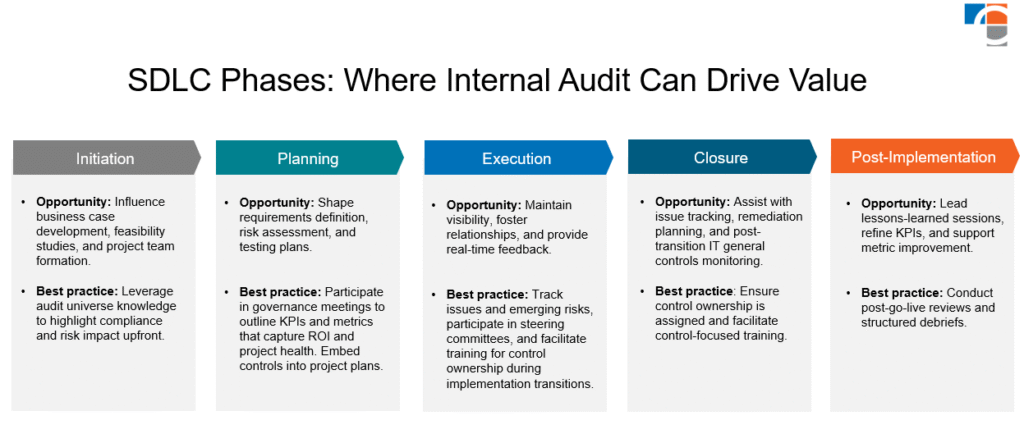
The earlier internal audit is involved in the SDLC, the greater the impact. Waiting until implementation means missed opportunities to influence design, governance, and risk mitigation. Internal audit’s value is maximized when it “shifts left,” engaging early and often and becoming a trusted strategic partner to management and the executing teams in risk identification and control implementation. Visualized below are some of the key opportunities and best practices for internal auditors to make a demonstrable impact during each phase of the SDLC:
Elevate the Impact of Your Internal Audit Function
Internal audit’s expanded role in the SDLC is a strategic advantage. By engaging early, embedding controls, and partnering with stakeholders, internal audit can drive project success, strengthen compliance, and deliver measurable business value.
Ready to shift left? Connect with CrossCountry Consulting to learn how your internal audit function can become a true partner in system development.