
Most finance teams never waited for permission to start using generative AI. Today, analysts paste reconciliation data into ChatGPT. Controllers’ draft memos with Copilot. No one approved a rollout plan; it just happened, one browser tab at a time, and it continues to expand the same way.
This is the adoption gap sitting inside most finance functions today.
Generative AI in finance is spreading through informal, everyday use, well ahead of any real fluency in how to govern, document, or trust what it produces. Organizations that deploy agentic AI directly inside Sarbanes-Oxley (SOX) controlled processes, where the margin for error is thin, keep finding the same pattern.
Adoption is not the hard part. Fluency is.
Closing that gap requires more than better tools or stricter policies. It requires finance professionals who understand precisely where AI belongs inside a controlled process and where it does not. That kind of judgment does not come from general AI awareness; it comes from function-specific AI training that connects AI capabilities to the realities of financial reporting, SOX compliance, and audit readiness.
What is the generative AI adoption gap in finance, and why does it matter?
The AI adoption gap is the distance between organizations using AI and those capturing real value from it. The value comes from the operating model, not the technology itself.
- Adoption is widespread, but value is not. According to McKinsey’s State of AI 2024 research, 72% of organizations have adopted AI in at least one business function.
- People and process drive the real return, not the technology. BCG’s 10-20-70 rule holds that successful AI transformation is 70% people, process, and operating model change; 20% technology and data; and only 10% algorithms.
- Only 6% of companies have made enterprise AI genuinely work at scale. Scale AI’s Six Percent Report, a 2026 study of nearly 500 senior AI decision-makers conducted with Reuters Insights, found that most organizations are still far from realizing enterprise-wide impact.
For finance, this gap carries a compliance dimension that most functions have not fully reckoned with. Every general ledger entry, reconciliation, and management judgment touched by an AI tool is within the scope of SOX Section 404 and internal control over financial reporting (ICFR). An analyst using an ungoverned tool to draft a journal entry memo creates a control gap for the moment output enters the record, regardless of whether anyone intended it that way.
CrossCountry’s research, conducted in partnership with the Financial Education and Research Foundation (FERF) found that nearly half of organizations (46%) lack formal AI governance structures, and only 7% of finance leaders report being “very confident” in interpreting AI outputs. Widespread use, minimal governance: that combination is adoption without fluency.
Why does ungoverned AI use create SOX risk?
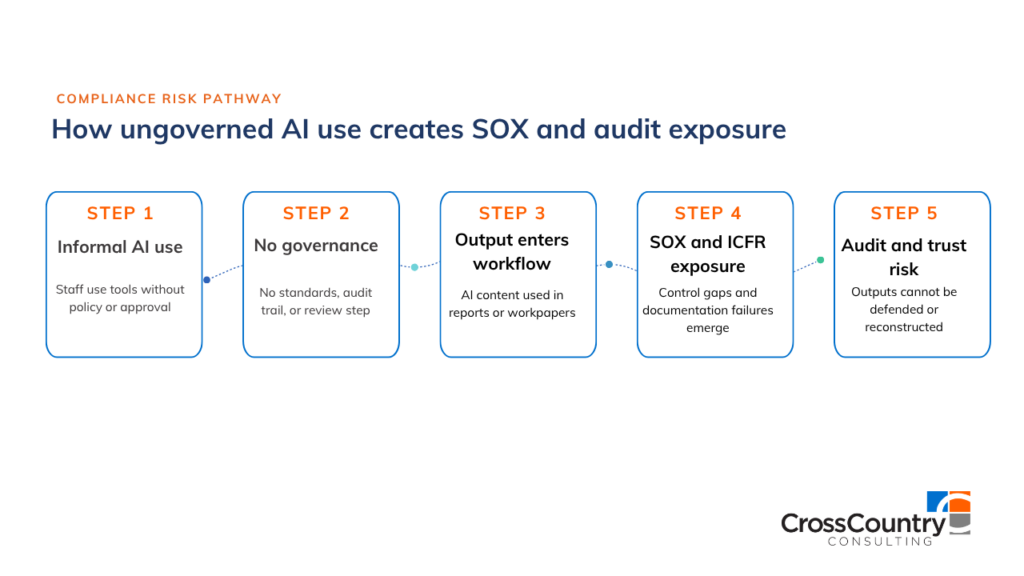
Ungoverned AI adoption fails in recurring ways, each with a distinct SOX exposure.
- Unvetted outputs enter the financial record.
- No audit trail for AI-assisted judgment.
- Inconsistent tool use across a shared process.
None of these failures happened because of negligence or a bad tool. They happen when adoption outpaces governance. “Our team is already using AI” is not the same statement as “our AI use is under control.”
What can governed agentic AI deliver in finance?
Governed agentic AI produces measurable, auditable results, not just efficiency anecdotes. The difference shows up clearly when AI is built into the control environment from the start, rather than layered on top of it.
Across recent SOX-focused agentic AI deployments, success metrics include:
- 500 hours recovered annually through automated control execution and testing
- 100% detection accuracy on targeted control exceptions
- 60% reduction in manual document preparation time
- 95% consistency in documentation output across control cycles
- 8% reduction in overall process tim
Source: CrossCountry Consulting AI Innovation Lab, SOX IT testing engagement.
These outcomes were a result of work in the AI Innovation Lab where CrossCountry operates multiple specialized agents on an internally built orchestration layer that functions as a command center across all agent tasks. An agent that flags an exception and logs its reasoning is fundamentally different from a chatbot and an analyst that consults. One is a controlled process. The other is a liability waiting for the next audit cycle.
The technology was not the variable that separated a 6% enterprise success rate from a 100% detection rate. Workflow design, governance, and the people running the process were.
Why fluency, not tools, separates finance functions that get AI right
The gap between AI adoption and AI value is, at its core, a judgment gap. Finance professionals operate inside some of the most controlled, highest-stakes workflows in any organization, where every output has an auditor, regulator, or board waiting behind it. General AI awareness does not equip them for that environment.
Knowing that a tool can summarize a document is not the same as knowing whether that summary belongs in a workpaper, who is responsible for verifying it, and how to document that verification in a way that holds up under ICFR scrutiny.
This is why function-specific AI fluency has become an operational priority, not a training initiative. Finance teams that develop genuine AI fluency are better positioned to govern existing tool usage, reduce control gaps created by informal adoption, and make credible decisions about where AI should be embedded. For a deeper look at why AI fluency has become a strategic competency for finance leaders, QuantumRise outlines the business case.
Elevate your finance team’s AI fluency with training solutions
The organizations closing the adoption gap are not simply deploying better tools. They are building the institutional judgment to use those tools responsibly.
CrossCountry and QuantumRise built the Applied AI Fluency for Business workshop to close that specific gap. This one-day program takes finance, accounting, and risk professionals from AI foundations through hands-on workflow redesign, with SOX governance built in from the start.
- AI foundations: how large language models (LLMs) and agents work, and where they fail.
- Hands-on lab: real finance workflows applied inside a persistent AI project.
- Agentic workflow redesign: mapping a live process, identifying where AI fits, and building SOX governance in from the start.
Participants leave having redesigned one of their own workflows, with governance considered from the outset instead of retrofitted later.
The gap between finance functions that get AI right and those that don’t will not close through better tools. It closes through people who know precisely where those tools belong. Give your team the foundation to use AI with confidence.
About this series: This article is part of a joint thought leadership series developed by CrossCountry Consulting and QuantumRise. Together, the two firms offer AI for the Office of the CFO, a practical AI workshop designed specifically for professionals in Finance, Accounting, and Risk Management. To learn more, visit crosscountry-consulting.com/ai.
Frequently asked questions
What is the difference between AI adoption and AI fluency in finance?
AI adoption means employees are using AI tools, often informally. AI fluency means the organization understands where those tools fit inside controlled processes, has documented that usage, and can defend the outputs under audit. Adoption without fluency is where compliance risk concentrates.
Does using generative AI in finance create SOX compliance risk?
Yes, when AI touches a process inside ICFR scope without a defined review step, audit trail, or consistent usage standard across the team performing the control. The risk comes from the absence of governance, not from AI itself.
What results has CrossCountry achieved with agentic AI in finance?
In SOX-focused deployments, our agentic AI solutions have recovered 500 hours annually, reached 100% detection accuracy on targeted control exceptions, cut manual document preparation time by 60%, and improved documentation consistency to 95%. Learn more about our AI Strategy and Transformation capabilities.